
Presidio Heights balances proximity to the best of the Bay Area with privacy and a sense of connection to more natural surroundings.
It sits at the northwestern edge of the city, tucked between Pacific Heights and the Presidio itself, and it operates by a different set of rules than most of San Francisco. The streets are wide and tree-lined, and the homes have that quintessential San Francisco Victorian mansion vibe that you find in other upscale neighborhoods. What Brentwood is to Los Angeles, or Kensington to London, Presidio Heights is to San Francisco.
The homes are large. The turnover is low. Median sale prices have been running north of $5 million, and eight-figure asking prices are not unusual for the right property. The people who live here arrived with intention and tend to stay.
In this article, I’ll cover what makes Presidio Heights worth understanding as a neighborhood, what the housing stock actually looks like, and what buyers typically encounter when they start thinking about what a home there could become.
Where Is Presidio Heights in San Francisco?
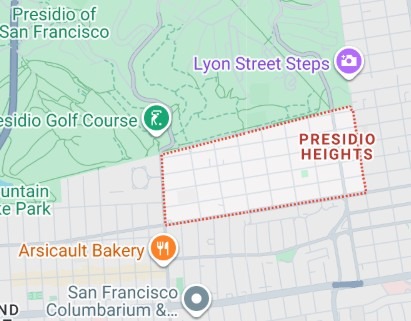
Presidio Heights runs east to west from Presidio Avenue to Arguello Boulevard, and north to south from Pacific Avenue down to California Street. It is a small neighborhood by area (under half a square mile) and a large one by almost every other measure.
To the east, it borders Pacific Heights directly, sharing the same ridgeline and many of the same streets. To the west and north, it borders the Presidio National Park, which means the neighborhood’s edge is not another neighborhood but 1,500 acres of trails, forest, and views of the Golden Gate Bridge. That distinction matters architecturally and practically. No commercial developments press against the neighborhood from that (or any) side. No noise. No density. Just the park. And for those who can afford to move here, that’s the best of San Francisco.
Sacramento Street runs through the neighborhood’s core and carries most of its retail life: Bryan’s Market, Spruce, Boichik Bagels, boutiques, cafes. California Street provides the southern boundary and additional access to transit and shopping. Julius Kahn Playground at Jackson and Spruce gives families with children one of the better-maintained parks in the city.
Fog-wise, Presidio Heights sits far enough inland from the ocean to catch more afternoon sun than the Richmond or Sunset while still benefiting from the Presidio’s buffering effect on winds. For anyone planning a renovation around solar exposure, that distinction is worth noting early.
Who Lives in Presidio Heights?
The neighborhood’s 4,127 residents skew older (median age 47), higher-earning (average household income $184,000), and highly educated (83% college graduates). It is not a neighborhood that turns over quickly or attracts a transient population. The people who buy here tend to have already lived in San Francisco long enough to know exactly what they want, and Presidio Heights is the answer they arrived at.
Families with school-age children value the proximity to San Francisco University High School, one of the city’s most respected private schools. Professionals who have reached a point in their careers where they are no longer optimizing for nightlife or urban energy value the quiet, and the opportunity to spend moments at home with their closest circles. The Presidio Association of Neighbors is active and organized. The neighborhood has a genuine community infrastructure (much like what you find in Beverly Hills) and services.
What draws the current wave of tech-sector buyers is slightly different. The combination of privacy, proximity to the Presidio’s trail system, and the quality of the housing stock makes Presidio Heights function as a retreat that is still 30 minutes from anywhere in the city. That is a rare configuration at this price point, and buyers who have looked at comparable properties elsewhere in San Francisco tend to recognize it when they see it.
The Homes of Presidio Heights
Most of the residential housing stock dates from the early 1900s through the 1930s and is predominantly Edwardian in character, with some Beaux-Arts and Tudor examples representing the neighborhood’s upper register. The Roos House at 3500 Jackson Street (1909, Willis Polk) is among the most architecturally significant residences in the city.
The homes are large by San Francisco standards, on lots that are generous by any urban standard, with setbacks and gardens that are unusual in a city where most parcels are tightly constrained.
What buyers inherit with these homes is a specific set of trade-offs. The bones are usually good. The scale is right. The location is irreplaceable. What typically needs attention is everything behind and inside the walls: dated finishes, fixtures, cabinetry, electrical systems, plumbing, insulation, seismic performance. Many of the neighborhood’s Edwardian structures have ground-floor garage/storage configurations that create layered vulnerabilities, meaning the ground level lacks the structural continuity of the floors above it. This is a known issue in pre-war SF construction, known as a “soft story,” and something a structural engineer will flag in any serious inspection. The other recurring issue is floor plan logic. These homes were designed for a domestic life organized around formal rooms, service corridors, and staff quarters. Converting that logic into something that works for the way people actually live today (open kitchens, connected living spaces, indoor-outdoor access) is the architectural problem that most buyers in this neighborhood eventually face.
If you are buying a home in Presidio Heights, you are often not simply buying the house you see. You are buying the potential of the house.
Buying or Renovating a Home in Presidio Heights
The most important thing to understand before purchasing in Presidio Heights is that the neighborhood’s historic character comes with real constraints. San Francisco’s planning department and the Department of Building Inspection treat properties in this area carefully. Alterations to exteriors, especially facades visible from the street, require review, and expansions trigger neighbor notification. That is not a reason to avoid renovation. It is a reason to understand what is and is not possible before you are under contract.
The renovations that tend to work best in Presidio Heights are the ones that leave the exterior largely intact (with any needed restoration in kind) and concentrate the architectural work on the interior. Opening floor plans, improving light distribution through rear or vertical additions and skylights, creating usable outdoor space at the rear or roof level, and addressing systems (electrical, HVAC, basement, seismic) are all areas where the planning exposure is manageable and the impact on daily life is significant.
Buyers who run into trouble are typically the ones who start with a design vision before understanding the constraints and what this will take. Presidio Heights lots are large but not simple. Setbacks, slopes, height limits, and neighboring conditions all shape what is buildable. Getting that picture before design begins is not a luxury. It is the difference between a project that moves efficiently and one that stalls.
Planning a Renovation in Presidio Heights
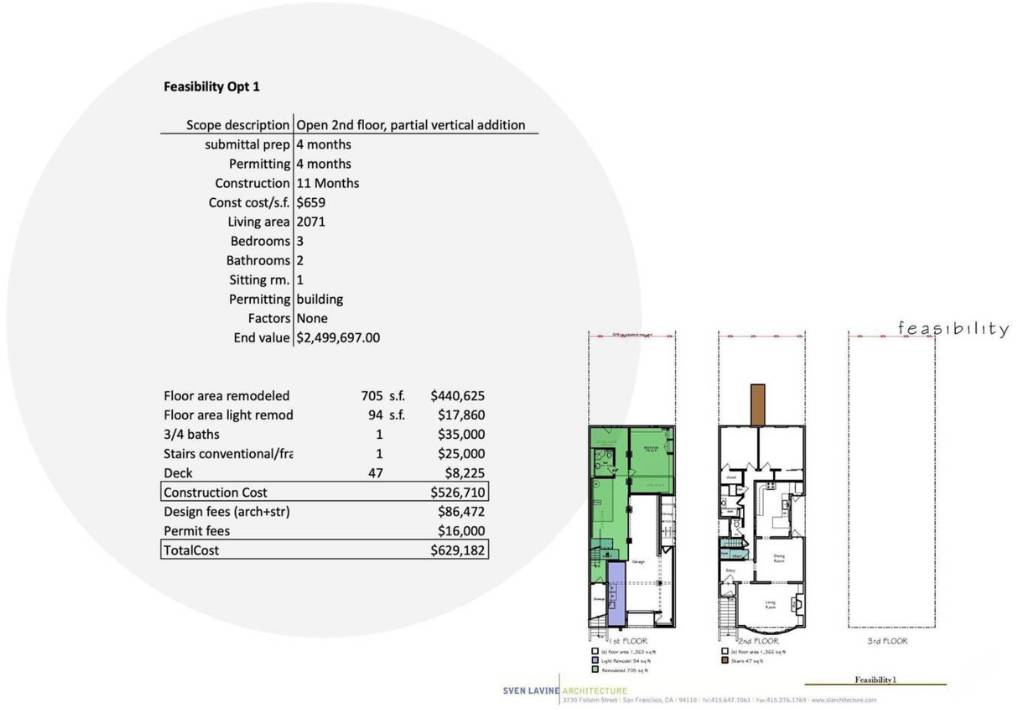
What I find with Presidio Heights projects is that the feasibility conversation is where most of the groundwork is laid. The client usually arrives knowing they want more light, a better kitchen, a primary suite that makes sense, and an outdoor connection that the original floor plan never considered. What they do not yet know is which of those things is straightforward, which will require permits and planning review, and what it will all cost before a dollar goes into design.
That is what a feasibility study resolves. Site constraints, buildable envelope, scope options at different budget levels, permitting exposure, preliminary cost modeling. Done before design begins, it means the design phase produces something the client can actually build rather than something that has to be renegotiated halfway through.
Local knowledge matters here in ways that are hard to overstate. I know the permit office. I know the planning staff who review projects in these neighborhoods. I know where the process tends to slow down and where it moves faster than most people expect.
If you are thinking about a home in Presidio Heights and want to understand what a renovation could realistically involve, that conversation starts with a free 40-minute Design Discovery Session.